
Hypersonic Trajectory & Heat Flux Trade
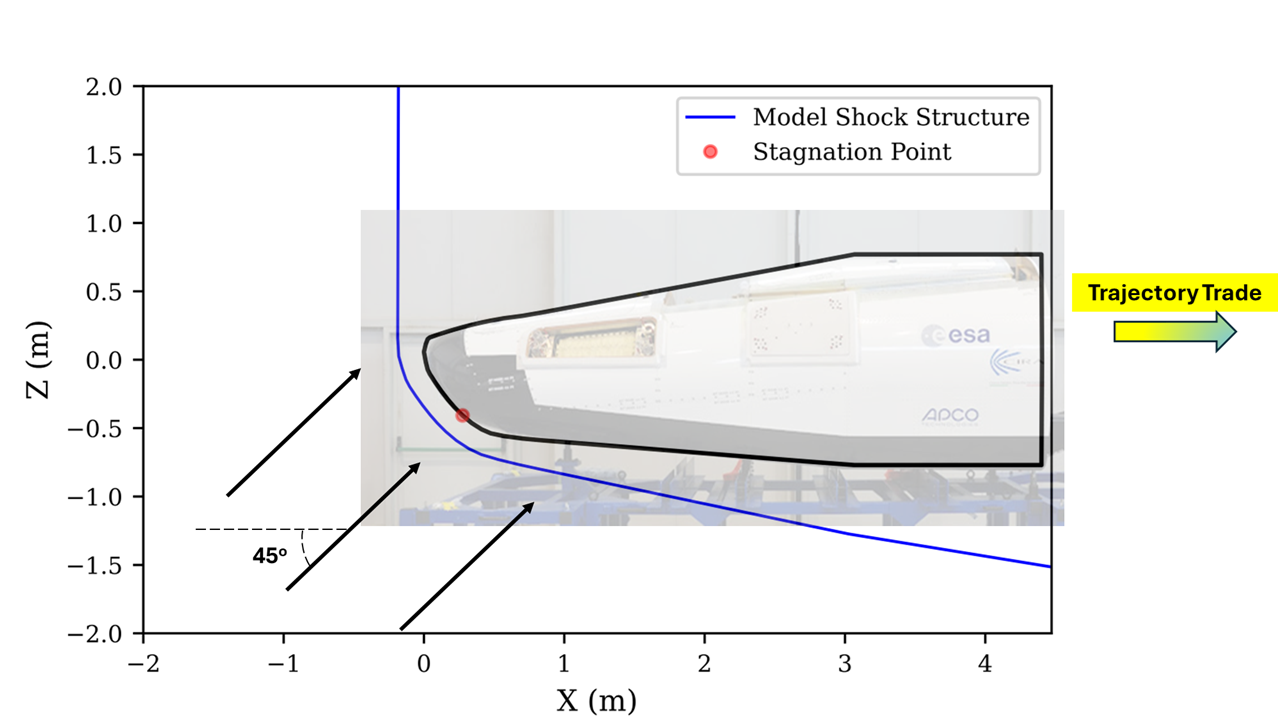
In hypersonic reentry, the difference between a viable trajectory and a failed one is often dictated by stagnation heat flux. Understanding how trajectory choices interact with peak aerothermal loads is therefore central to hypersonic mission design. Here, we take a stagnation heat flux perspective to examine how optimized reentry trajectories are arrived at. To demonstrate this, we analyze the Intermediate eXperimental Vehicle (IXV) mission using a 3-DoF trajectory model, advanced Billig shock structure relations, and Tauber’s stagnation heat flux model.
The IXV mission was successfully completed in February 2015 using a blunt reentry geometry at a nominal angle of attack of 45°, a reentry velocity of ~7.5 km/s, and a vehicle mass of ~1900 kg. The most intense heat flux experienced during a reentry occurs at the stagnation point. Using Tauber’s model, we can map the stagnation heat flux over altitude–Mach space. It is evident that higher Mach numbers and lower altitudes result in rapidly increasing heat-flux values, primarily due to the M^3 dependence of stagnation heat flux at a given altitude.
IXV Trajectory Trade
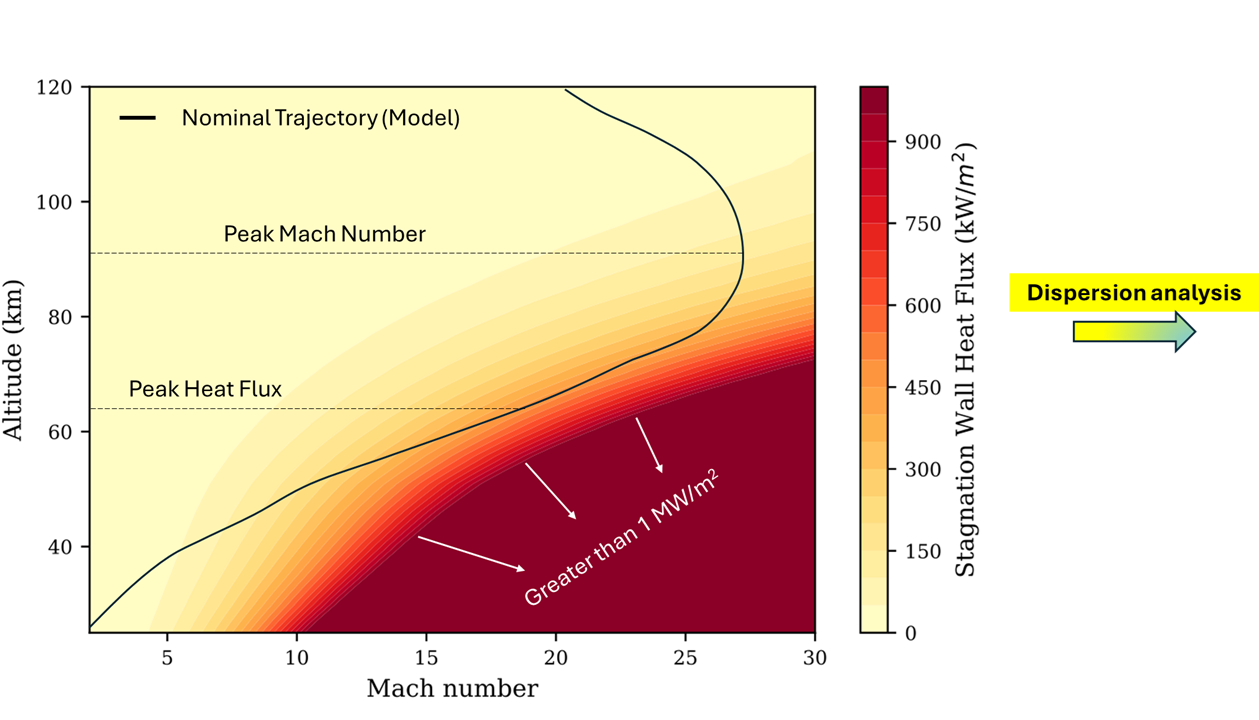
When the IXV trajectory is overlaid on the altitude–Mach space, it becomes clear that the trajectory is intentionally designed to avoid severe thermal environments at the stagnation point. It is also notable that the altitude corresponding to peak Mach number - often in the rarefied regime during reentry - does not coincide with the altitude of peak heat flux, which typically occurs in denser atmospheric regions.
How does parametric dispersion affect peak reentry heat flux?
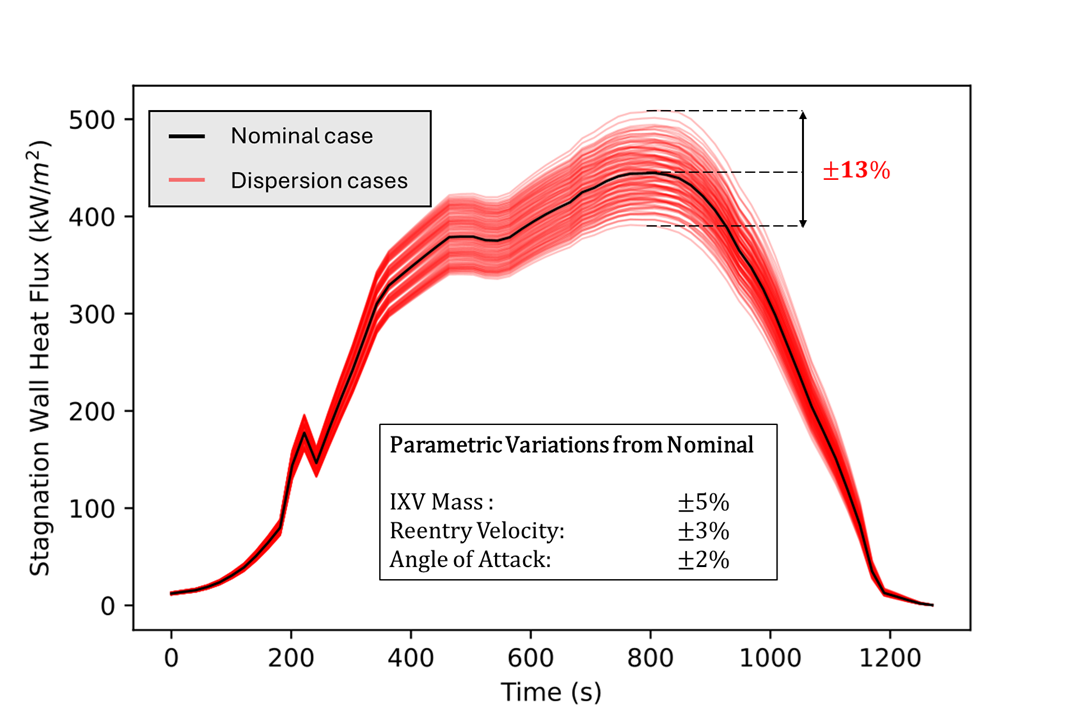
Uncertainties in mission parameters can lead to non-linear dispersion values on mission performance. Here, we examine variations in IXV mass (by 5%), reentry velocity (by 3%), and angle of attack (by 2%) to estimate the resulting variation in peak stagnation heat flux. By mapping the evolution of stagnation heat flux for both dispersion cases and the nominal trajectory, it is evident that the resulting dispersion in peak stagnation heat flux is approximately 13%.
What is the significance of these results?
Trajectory mapping and uncertainty quantification are among the most challenging problems in the design and execution of hypersonic reentry missions. The ability to map mission objectives across a parametric space can significantly accelerate the design lifecycle. In addition, assessing uncertainty in mission objectives using a physics-based digital twin substantially improves mission reliability. As a result, digital twins infused with multidisciplinary, physics-based system models are essential to accelerate development, enable confident scale-up, and enhance operational reliability across the hypersonic system lifecycle.
